


 His Life, Legacy, and Power Off the Tee

Born June 16, 1821, in a modest weaver’s cottage in St Andrews, Fife, Thomas Mitchell Morris—known to history as Old Tom Morris. Old Tom would come to shape the game of golf in ways no one then could imagine. From swinging crude gutta balls on muddy links to designing courses that endure still today. From battling Allan Robertson to raising Young Tom Morris, his life is woven into the very fabric of golf’s origins. This is the story of Old Tom—not just the championships, but the man, the maker, and how far he could truly hit a golf ball.
Early Life and Beginnings
Thomas Mitchell Morris was the sixth of seven children born to John and Jean Morris. His family were weavers; his mother’s side was too. A traditional working-class childhood in St Andrews, with little formal schooling beyond basic literacy, was his lot. But golf called early. By the time he was five he was being drawn to the links; by age ten he was inventing games—knocking wine-bottle corks fitted with nails around town using a homemade club in “sollybodkins” matches with other local lads.
From those childhood matches he graduated to caddying. At 14, he became an apprentice to Allan Robertson, already acknowledged as the world’s top professional golfer, and owner of the golf equipment trade at St Andrews, as well as custodian of its links. Morris served four years as apprentice and then about five more as a journeyman under Robertson. These were formative years: learning club-making, ball-making, course care, match play, etiquette, and the emerging culture of professional golf.
Playing Alongside Allan Robertson – “The Invincibles”
In the early 1840s, Old Tom caught Robertson’s eye as a golfing partner in challenge matches. Match play in “alternate shot” format was the principal competitive form then. Robertson and Morris became a team often called “The Invincibles”—and for good reason: few teams, if any, when they played on even terms ever beat them. Around 1843, a young Morris even won an informal match over the Old Course against Robertson, showing his rising skill. But head-to-head formal play between them was rare.
That said, Morris’s skill was undeniable. He was among the very best by his early 20s—second only to Robertson in St Andrews, perhaps in Scotland. He was not renowned for blistering power, but for consistency, creativity, strategic intelligence, and unrivaled knowledge of the turf, wind, and equipment.
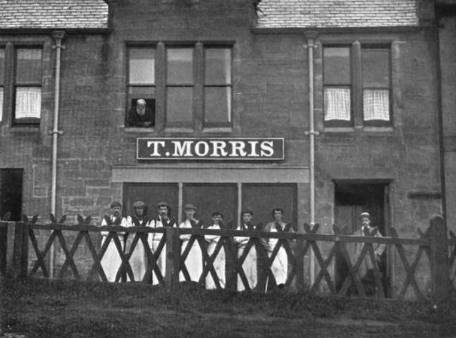
The golf shop of Old Tom Morris in St Andrews, Scotland, c. 1890. Morris is looking out the second storey window (upper left).
The Guttie Dispute and Break with Robertson
A turning point came in the late 1840s. Golf balls, which until then had been made by stuffing feathers into stitched leather casings (featheries), were expensive and delicate. A new type, the gutta-percha ball (guttie), made from the sap of a tropical tree, offered durability, lower cost, and different flight characteristics. Tom Morris saw potential in the guttie; Allan Robertson did not, at least not initially—Robertson had an established business in featheries and had a vested interest in their continued dominance.
The story goes: Morris lost all his featheries during a match with a Mr. Campbell of Saddell, who lent him a guttie. Morris liked it, used it, played well with it—and word reached Robertson. When they next met, words turned heated; the disagreement was irreconcilable, and Robertson fired Morris on the spot. This was not just a job lost—it was a philosophical divide over equipment, progress, and the future of the game.
Prestwick, James Fairlie, and a New Chapter
After the break with Robertson, Morris’s fortunes took a turn. With the support of James Ogilvie Fairlie, a man of means and influence, Tom Morris and his wife Nancy (they had married around 1844) moved in 1851 to Prestwick. (Their first born, also Tommy, had died in 1850 at age four; Young Tom Morris was born later in 1851.)
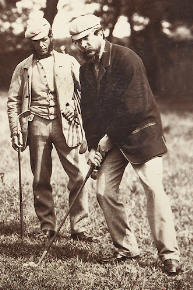
Old Tom Morris (left) with James Ogilvie Fairlie, c. 1850
At Prestwick, Morris did much more than play. He was greenkeeper, club-maker, ball-maker, course designer, instructor, and more. Old Tom laid out a 12-hole course there, honing design principles and greenkeeping skills which would mark all his later work. He also sold gutties and clubs, embracing the new equipment that had cost him his job with Robertson.
Championships, Matches, and Rivalries
When The Open Championship launched in 1860, Morris was there. He came second in that first Open—but won outright in 1861, the first-year amateurs were allowed. He then went on to win again in 1862, 1864, and 1867. Remarkably, he remains to this day the oldest winner of The Open—he was 46 when he last took the title. His victory margin in 1862 was 13 strokes—a record for a major championship that stood until Tiger Woods’s 2000 U.S. Open.
Morris’s rivalry with Willie Park (of Musselburgh) was intense and enduring. Matches between them, frequently for large wagers, drew great local interest. Park won many of their head-to-head matches, but Morris always respected him; Morris himself once said Park was “as good a golfer as ever lifted a club.” Local pride, town rivalries (St Andrews vs Prestwick vs Musselburgh), and the betting culture of match play magnified these contests—they were not just games, but spectacles.
He also had the father-son partnership with Young Tom Morris, perhaps both rewarding and painful. Together they played challenge matches, often alternate shot, and impressed the golfing world. But their approach, styles, expectations and the tragedy of Young Tom’s early death (1875) would leave deep marks on Old Tom Morris, personally and in his reputation.
Course Architecture and Greenkeeping – Shaping the Game
Old Tom Morris’s influence extended well beyond playing. He designed or remodeled about 75 golf courses throughout the British Isles. Among the most significant are Prestwick, the Old Course at St Andrews, Muirfield, Royal Portrush, and Carnoustie. His work included:
- Laying out 10 holes at Carnoustie while still apprentice to Robertson. He then later remodeling and extending it to 18 holes in the 1870s.
- Designing the Kingussie Golf Club in 1895; Kinghorn in 1887; and Kirkcaldy. He also designed numerous others in Scotland, Ireland, the Isle of Man, England.
- Creating putting courses, notably The Himalayas in St Andrews in 1867—a 9-hole (later extended) putting and miniature links course for the St Andrews Ladies Golf Club. It may have been the first of its kind.
His greenkeeping innovations were fundamental and still used:
- Using sand top-dressing on greens to improve turf density and uniformity;
- Pushing mower for cutting putting greens;
- Drainage, irrigation, better soil management (lime, fertilizers, compost);
- Yardage markers; separate teeing areas; widening fairways; and strategic handling of hazards—hazards that weren’t just obstacles but parts of strategic course design.
When he returned to St Andrews in 1864 (after the R&A formally asked for his rehiring), Old Tom took up the post of Keeper of the Green and Professional at a salary of £50/year, a generous sum for that time. St Andrews was in poor condition then; Morris set about restoring it: widening fairways, enlarging and improving greens, building new greens for hole 1 and 18, managing hazards, applying approaches he had fine-tuned at Prestwick. He held that post until 1903—39 years—and even after that remained on full salary.
How Far Could Old Tom Morris Hit a Golf Ball?
A question many golf fans wonder: in his day, with the equipment available, how far could Old Tom Morris drive or hit a full shot?
Using the gutta-percha ball, which he adopted after parting ways with Robertson, Morris was not particularly known for overpowering drives. Still, sources suggest he could send the guttie approximately 200 yards under good conditions (fair wind, firm ground, favorable lie). Variables like wind, turf condition, slope, and ball design could shift this. His strength was not raw distance, but precision, course-management, shot-making variety, and winning decisively when it mattered.
So, when you see golfers today driving 300+ yards with modern drivers and ball technology, remember: Old Tom was doing commendable work with much more rudimentary tools.
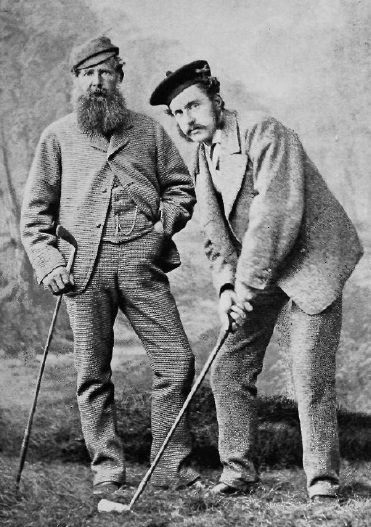
Old Tom Morris with Young Tom Morris, c. 1870-75
Later Life and Legacy
Old Tom’s twilight years were still richly productive. He continued designing courses, tinkering with turf, teaching, and working on the Old Course and other projects into his 80s. One of his last 18-hole designs was Killermont course in Glasgow (opened 1904), just four years before his death.
He died at almost 87 years old on May 24, 1908 in St Andrews, in Memorial Cottage Hospital, after falling down a flight of stairs in the clubhouse of The New Golf Club. He is buried against the eastern wall of St Andrew’s Cathedral’s churchyard, beneath his own simple grave—but across the yard stands the monument to his son, Young Tom Morris, with a bronze statue in high relief. Many golfers come each year to pay homage at both graves.
In 1976, Old Tom Morris was inducted into the World Golf Hall of Fame—an appropriate recognition of a man whose contributions spanned every dimension: playing, designing, maintaining, innovating.
Why Old Tom Morris Still Matters
It’s tempting to relegate Old Tom to golf’s history books, heavy in nostalgia, soft in relevance. But that undervalues what made him a foundational figure:
- He helped standardize many of the features we now take for granted—yardage markers, 18 holes, tee boxes, strategic hazards.
- He married craftsmanship (making balls and clubs) with playing excellence and course design, giving him deep understanding of how all parts of the game interact.
- His rivalry with contemporary professionals like Allan Robertson and Willie Park elevated the sport: truly competitive matches, spectators, betting, public interest.
- His father-son relationship with Young Tom adds both inspiration and tragedy, humanizing him.
Through it all, Old Tom Morris was not simply a great golfer; he was a pioneer. He bridged eras—from featheries to gutties, from amateur elites to the beginnings of organized tournaments. He helped define what professional golf could be.
Old Tom Morris didn’t hit the ball as far as today’s long-drive champions—but in his own era, with his equipment, about 200 yards with the guttie was impressive. More important than sheer distance was his vision: better balls, better courses, better greenkeeping, better competition. He transformed golf from a local pastime into a structured sport with global reach.
When you stroll the Old Course, tee off beside hazards thoughtfully placed, read the green, or marvel at a well-designed hole that asks more of your head than your muscle—thank Old Tom Morris. His legacy isn’t just in the history books, but in every round played on a course he touched, every green kept tender yet strategic, every young player inspired by the past.